
What Investors in Australia and Japan Actually Think – Capital Without Borders Session Recap
Most investor panels are performance.
The investor says what sounds good. The founder takes notes. Everyone leaves with more questions than they arrived with.
This session was different.
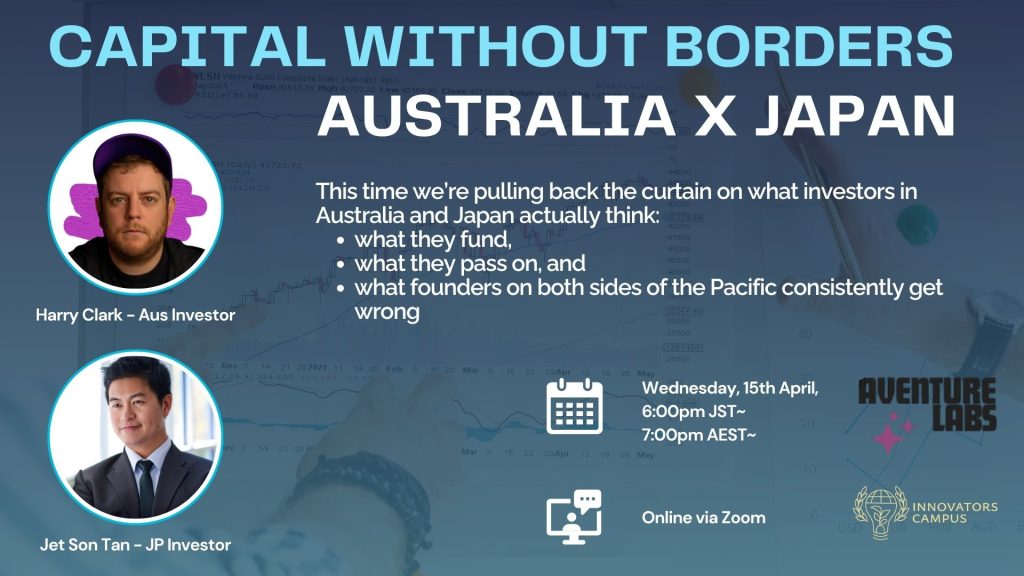
Harry Clark and Jet Son Tan gave a genuinely unfiltered view of how investors in Australia and Japan think – what gets them curious, what makes them pass, and what founders consistently get wrong before they ever get to a term sheet.
Here are the key takeaways.
The investors in the room
Harry Clark is a habitual founder and venture studio operator, co-CEO of AventureLabs, building at the intersection of AI, deep tech, and venture capital across APEC and EMEA. He sits on both sides of the table and spent the session giving the kind of feedback most investors only share after the meeting is over.
Jet Son Tan is a Tokyo-based angel investor and serial entrepreneur with product experience across Apple, TomTom, and six startups, including building Siri for the Southeast Asian region. He is a Founder Institute mentor across Japan, South Korea, and Southeast Asia, and is currently building his seventh startup in Japan in the fintech space.
The session was facilitated by Matt Ainsworth (Tech Bridge Studio) and Thom Peace (Innovators Campus).
What actually makes an investor want to know more
Harry put it simply. The founders who get follow-on questions every time are the ones who can tell the story clearly in a couple of sentences.
Not the market size. Not the technology. The problem, why them, and why now.
If you can explain what you’re building and why it matters in a short elevator pitch – and the person you’re talking to asks you a follow-on question rather than nodding politely – that’s the signal you’ve nailed it. Harry’s test is simple: practice your intro at networking events. If you get the same follow-on questions repeatedly, you’re on the right track.
Jet added that every investor is different. Some invest based on social goals. Some are passionate about backing young founders. Some are deep domain experts who only back founders solving problems they personally understand. Knowing your investor before you pitch is not optional.
The TAM mistake that kills more pitches than anything else
Harry was direct about this one. Opening a pitch with a massive total addressable market figure – “the global market is worth hundreds of billions” – without connecting it to a specific painful problem that real people are paying to solve is one of the most common and most damaging mistakes founders make.
What he wants to hear instead: we spoke to 30 or 50 people who have experienced this specific problem this week. Here’s what it costs them in time or money. Here’s exactly how our product removes it.
Big market, tiny focus. A narrow, clearly defined customer group with a problem they feel acutely. That’s the pitch that lands.
Traction is not a waitlist
The second big pattern Harry called out is founders confusing a good idea with real traction.
Ten thousand email signups is still the idea phase. Real traction looks like revenue, clear monetization events, active users who are logging in and taking action, and repeat engagement. Not a once-off sign-up. Evidence that people keep coming back.
Even small revenue matters more than a large waitlist. An investor who sees a founder with fifty paying customers thinks differently than one who sees fifty thousand email addresses.
How Japan is different – and what founders get wrong
Jet was clear that Japan is not like the rest of Asia. His words: it’s a little bit like Mars on Earth.
The biggest mistakes international founders make when approaching Japan:
Assuming they can plug in a product that works elsewhere and expect it to run. Japan requires localisation that goes beyond translating the website. The way decisions are made, the way trust is built, and the way products get adopted are all fundamentally different.
Mistaking interest for commitment. Japanese investors and business partners will show a high level of interest as a matter of respect. That is not a yes. Ninety-nine percent of the way there and the deal still doesn’t close – usually because the final layer of trust hasn’t been established.
Going in without a local partner. Having someone who is actually based in Japan, who understands the local market and has existing relationships, changes everything. Without that, the timeline stretches significantly.
On timing, Jet was honest. Building the right relationships in Japan takes a minimum of six months if you already have considerable traction and proof. More realistically, a year.
What Japanese investors are backing right now
Jet pointed to several sectors getting serious attention in Japan currently: manufacturing, semiconductors, workflow optimisation, business AI, biotech, aerospace, and cybersecurity.
The framing matters too. AI in Japan is not seen as hype. It’s seen as a tool to optimise existing solutions, not replace entire systems. Pitches that lean into that framing land better than pitches that promise disruption of established ways of doing things.
Japan, as Jet put it, runs on a principle of not fixing what isn’t broken. The products and startups that succeed build alongside what exists rather than against it.
What Australian VCs are watching
Harry pointed to real-world industries that are established, global, and now introducing technology for the first time as the space where Australian VCs see the biggest opportunities.
Education, real estate, manufacturing, and construction were his examples – industries that haven’t fully immersed themselves in technology yet but clearly have to. Founders who deeply understand a specific industry and are building a software solution to a problem they know from the inside are the ones getting the cheques.
How to build relationships with investors – from both sides of the Pacific
The consistent advice from both Harry and Jet:
A warm introduction beats a cold approach every time. If you know someone who knows an investor, use that connection. It changes the dynamic of the first conversation immediately.
Show up consistently. Attending events, being present in the right communities, and demonstrating traction over time matters more than a single perfect pitch.
Have your deal room ready. If you have a good conversation and an investor shows interest, being able to follow up immediately with evidence – a clean, organised set of materials in a shared folder – is what separates founders who close from founders who get forgotten.
Don’t go in before you’re ready. A lot of founders have investor conversations before they have the traction, the story, or the materials to back it up. That conversation might not get a second chance.
Where to show up in Japan
Several resources came up in the session for founders looking to build presence in Japan:
Venture Cafe Tokyo runs free weekly Thursday evening events across multiple locations including CIC Tokyo and Tokyo Innovation Base in Uracho. It is one of the most accessible entry points for English-speaking founders.
SusHi Tech Tokyo is the city’s flagship annual innovation event run by the Tokyo Metropolitan Government and a significant gathering point for both domestic and international founders.
Antler Japan runs a zero-day to one investment program for founders at the earliest stage.
Founder Institute Japan supports pre-seed founders through structured cohorts with access to a global investor network.
Tokyo Innovation Base in Uracho is a free workspace with regular events, worth checking if you’re spending time in Tokyo.
Where to show up in Australia
For founders building in Australia, Harry mentioned:
Stone and Chalk in Sydney and Adelaide. Fishburners and the Sydney Startup Hub. The Aussie Founders Club Slack community. Antler Australia for co-founder matching. LinkedIn for posting a co-founder position – Harry’s suggestion was to be very specific in the post and call it a co-founder position clearly, not a job.
Finding a co-founder – the honest version
This came up through a question from a founder in the session who had no team, no investment, and was using no-code tools to make progress alone.
Jet’s response was practical. Keep building with the tools you have. AI and no-code tools get you closer to proof before you need a technical co-founder. Keep attending events and meeting people. He found his co-founders through connections, through AngelList, and through different sources over time. There is no shortcut – it’s the same as any relationship. You meet enough people and eventually the right one clicks.
Harry added that sometimes the best angle is looking for someone building in the same space to collaborate with rather than compete. And that the person you’re looking for might not come from the startup world at all – some investors rotate back into building, and a conversation with a potential investor sometimes leads somewhere unexpected.
The closing line that says it all
Jet ended with the rule he uses in every pitch: if you can explain your idea so that a five-year-old understands it, you probably have a great pitch.
If you can’t, keep simplifying until you can.
What’s coming next
The next Innovators Campus session is a Venture Cafe in-person workshop on the 14th of May called ‘Tell me a story – how founders win with narrative’. Matt is also running an event with Business in Japan in Tokyo on the 15th, in Kyobashi, covering AI and investment opportunities in startups with an angel investor, a CTO, and a Founder Institute representative. Tickets are 3,000 yen including pizza, drinks, and networking.
Follow Matt Ainsworth (LinkedIn) or join the community below for details on both.
👉 Join the Australia x Japan Startups community – 13K+ members
FAQ
What do investors in Japan actually look for?
Japan investors are more risk-averse than most markets and look for clear proof of concept, local traction, and evidence that the founder understands the local market. Overly optimistic pitch decks get passed quickly. Products that complement existing ways of doing things rather than disrupting them have a better chance of gaining traction.
How long does it take to build investor relationships in Japan?
At minimum six months if you already have significant traction and proof. More realistically a year. Having a local business partner who understands the market and has existing relationships significantly shortens the timeline.
What is the biggest pitch mistake founders make when seeking investment?
Opening with a large total addressable market figure without connecting it to a specific, painful problem that real people are paying to solve. Investors want to hear about a narrow, clearly defined customer group and the specific problem they feel acutely – not a market size headline.
What sectors are Australian VCs focused on in 2026?
Real-world industries that are established and global but are only now introducing technology – education, real estate, manufacturing, and construction were highlighted. Founders who deeply understand a specific industry and are building software to solve a problem they know from the inside are the ones getting funded.
What is the difference between traction and a waitlist?
A waitlist is still the idea phase. Real traction is revenue, repeat engagement, active users taking action, and clear monetization events. Even small revenue counts for significantly more than a large email list when talking to investors.
Where can I find a co-founder in Australia?
Stone and Chalk, Fishburners, the Sydney Startup Hub, the Aussie Founders Club Slack community, Antler Australia, and posting a clearly labelled co-founder position on LinkedIn are all worth trying. Showing up consistently at the right events over time is the most reliable approach.
👉 Join the Australia x Japan Startups community – 13K+ members