
How to Tell Better Stories as a Founder | Five Storytelling Frameworks That Work in Any Room
Five Storytelling Frameworks That Work in Any Room
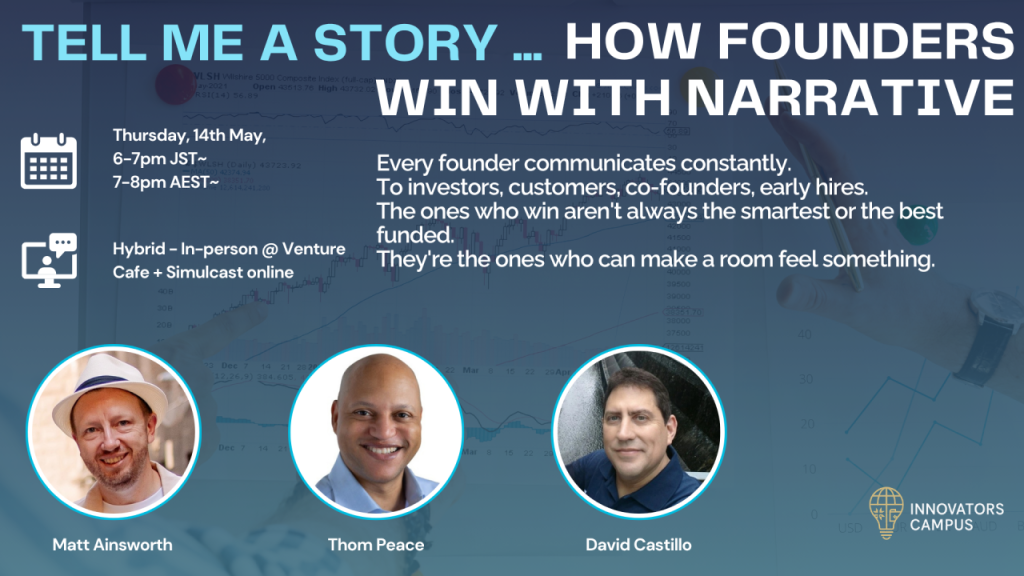
Venture Cafe Tokyo | Matt Ainsworth, Tom Peace, David Castillo
Nobody walks into a room thinking they are a bad storyteller. Most founders believe they can explain their business clearly. They know the problem. They know the solution. They have the numbers.
But there is a gap between explaining a business and telling a story that makes someone lean forward. Between describing what you built and making a room feel why it matters. Between a pitch that informs and one that moves people to act.
That gap is what brought a room full of founders and entrepreneurs to Venture Cafe Tokyo for a session called Tell Me A Story. And what happened over the next 54 minutes is worth unpacking.
What happened in the room
The session was not a lecture. It was a demonstration. Three speakers – startup mentor Matt Ainsworth, Tom Peace from Peace Works K.K., and business trainer David Castillo – each told a real story using one of five frameworks. Then they walked the room through the structure underneath it.
The opening question was deliberately low stakes. Who has told a story before? Every hand went up. Who has told one recently? Most stayed up. The point was made immediately – everyone already tells stories. The question is whether the stories are working.
It does not matter whether you are a non-native English speaker or a native speaker. Equally, we struggle to implement narrative into the way we communicate.
That framing mattered. The room included Japanese professionals pitching in their second language, international entrepreneurs navigating Japan, and experienced operators from the US who had been in business for decades. The frameworks were not for a specific type of founder. They were for anyone who has ever walked into a room and felt the story was not quite landing.
The story that started it all
In 2018, a 21-year-old founder named Ogawa San was preparing for his first international pitch competition. In English. A language he was still finding his way through.
He had already survived one failed venture. He had 20 employees, three mentors, and initial investment. He had put university on hold to back himself. His company, Timee, was connecting students and working mothers with flexible hospitality and gig economy work – and paying them the same day.
Over six weeks Matt and Ogawa San built a story together. The shogi games with his grandfather. The early failure. The vision to make people happy – which is why Timee’s mascot, a quokka from Perth, is always smiling.
The second last session Ogawa San came back having practiced relentlessly on his own. He delivered his entire five-minute pitch from memory without checking a note. His English felt like it had improved overnight. It had not. He had found his story.
He came third in the competition. He did not win the prize money. He did not care. Timee is now a billion-dollar company with over 800 staff and one of the highest-paying employers for engineers in Japan.
That story is the reason the session exists. Not because Timee became a unicorn. Because of what happened in the second last rehearsal – the moment a founder stopped reciting a pitch and started telling a story that was entirely and unmistakably his.
That is what these frameworks are for.
The five frameworks
Each framework is a different tool for a different room. They are not interchangeable. The one you lead with depends entirely on who is sitting across from you and what they need to feel before they will move.
1. The Origin Story Best for: investors, media, first meetings
The specific moment the problem became personally unacceptable to you. Not a market observation – a human experience. The test: can someone replace your name with anyone else’s in the story? If yes it is not specific enough yet. This is the why me story that tells investors you are not just capable of solving this problem – you were built for it.
2. The Villain Frame Best for: hiring, fundraising, culture
Every compelling story has an antagonist. For founders it is never a person – it is a broken system, an outdated belief, or an industry that stopped serving the people it was supposed to help. We exist to defeat X is more powerful than we solve Y. The best early hires do not join job descriptions. They join missions against a villain they also believe needs defeating.
3. The Before After Bridge Best for: sales, marketing, case studies
Your customer is the hero — not your product and not you. Before: what was their life like before you existed? After: what can they now do, feel, or achieve? Bridge: your product is the mechanism that moved them from one state to the other. Most founders write their case studies backwards – they lead with the product. This framework fixes that.
4. The Reluctant Expert Best for: PR, fundraising, content
You did not set out to build a company. You had a problem, the existing solutions failed you, so you built something yourself. Now others want it. The Reluctant Expert replaces founder ego with lived credibility. Think Netflix – a founder sick of paying late fees who accidentally built the world’s largest streaming platform. The business surprised them as much as it surprised the market.
5. The Future Newspaper Test Best for: partnerships, strategy, closing a pitch
Describe the world three to five years from now if your company wins. What headline does the journalist write? This reframes the pitch from here is what we are building to here is the change we are creating. Partners, strategic investors, and co-founders need to see the destination clearly before they commit. This is the story that closes rooms the Origin Story opens.
An audience member tried the Future Newspaper Test live. His company is exploring energy-backed currency using blockchain – a complex technical solution to a systemic economic problem. In two minutes he described the world he is building toward, the mechanism he created, and the headline a journalist would write if he wins. The room understood something they would not have understood from a technical explanation. That is the framework working.
Cross-border communication – the same story, different rooms
One of the most practical parts of the session was a comparison of how the same story needs to land differently depending on where you are telling it.
In Japan, presentations tend to be highly detailed. Dense charts. Small font. Two hours. The expectation is thoroughness. The relationship comes before the transaction and the first meeting is rarely about closing – it is about building the trust that makes closing possible later.
In Australia the expectation is almost the opposite. Get to the point. Keep it short. Make the ask explicit and early. Relationships are built on directness not ceremony.
In the US the room responds to vision first. Lead with the size of the opportunity. Make the ambition feel inevitable. If you lose their attention in the first three minutes you have probably lost it forever.
It is not country specific. It is audience specific. Do your research on who is in the room before you prepare – not after.
The same story. The same frameworks. The same founder. But the order, the emphasis, the register, and the pace all shift depending on which room you are standing in. This is not manipulation – it is fluency. The best communicators understand their audience before they open their mouths.
Delivery – three things that change everything
The final section covered the physical craft of telling a story in a room. Three tools most founders underuse.
Pause. When you want to leave a thought with the audience – stop. Let it sit. Western cultures are uncomfortable with silence and founders tend to fill it with the next point before the last one has landed. The pause is not dead air. It is the space where the story sinks in.
Pitch. Your voice moves through a story. High when you are covering details or asking a question. Low when you want to land a point. A flat vocal register across the entire pitch kills engagement no matter how strong the content is. The shift in pitch is the signal to the room that something important just happened.
Pacing. Move quickly through setup, context, and background. Slow right down when you get to the thing that matters. The contrast between fast and slow is what creates emphasis. If everything is delivered at the same pace nothing stands out.
An audience member added a fourth: body language. Eye contact signals confidence. Posture signals conviction. The physical delivery of a story is inseparable from the verbal one – and in cross-cultural rooms it carries even more weight because language is only part of what the room is reading.
The one thing to take away
Near the end of the session someone asked what advice the panel would give a young entrepreneur to avoid becoming part of the 90 percent who fail. The answer was practical and direct: validate before you build, talk to people, find out if anyone actually wants what you are making.
But the deeper answer was in the room all along.
Ogawa San did not come third because his business model was the best in the room. He placed in a competition held in a language he was still mastering because he had a story that was entirely and unmistakably his. He had practiced it until it was no longer something he was performing – it was something he was living.
That is what these frameworks make possible. Not a better pitch. A story that sounds like you – specific, human, and told in a way that makes the room care about what happens next.
Want to work through these frameworks properly?
Foundations and Founder Stage are built exactly for this — four and six weeks of structured storytelling and communication coaching for founders across AU and Japan. Learn more at innovators-campus.com